
Action Practice: Why Awareness Alone Does Not Stop Weight Regain
By Oscar Poon · May 24, 2026
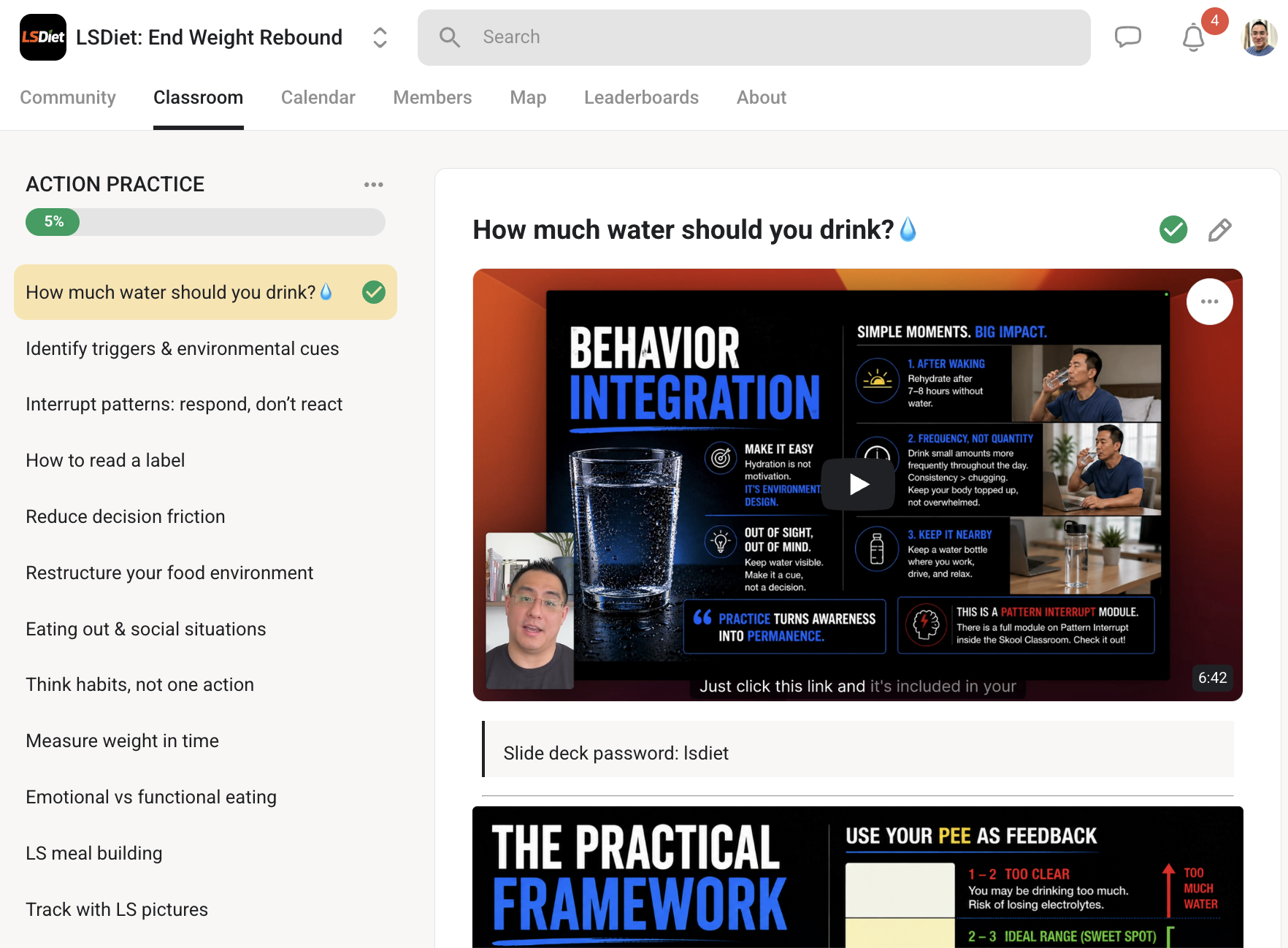
Awareness creates direction. Practice is what actually changes behaviour.
You can understand exactly why you regain weight, identify the patterns driving it, feel the full cost of staying the same, and have a clear picture of who you want to become — and still not change. Because none of that is implementation. Understanding and doing are two completely different things.
Action Practice is the implementation stage of the Weight Permanence Training™. It's where awareness becomes behaviour — not through motivation or willpower, but through deliberate, repeatable daily practice.
What Is Action Practice?
Action Practice is a set of daily behavioural modules built on one principle: consistency beats intensity, every time. The people who make permanent change are not the ones who try the hardest for the shortest time. They're the ones who practise the right things repeatedly until those things become automatic.
Each module targets a specific behaviour pattern identified in the awareness stages:
- interrupting emotional eating triggers before they fire
- redesigning environments that produce automatic overeating
- building decision routines that don't depend on willpower
- making the low-starch, low-sugar approach repeatable without overthinking it
- practising the identity-based responses that align with who you're becoming
The modules are available free inside the LS Diet Skool community. They run daily, take minutes, and are designed to stack — each one building on the last until the behaviour stops requiring conscious effort.
Why Awareness Alone Is Not Enough
The five Awareness Stages build a complete picture: where you are (Reality), what's stopping you (Friction), what keeps repeating (Pattern), what it's costing you (Consequence), and who you're choosing to become (Identity).
But awareness is a map, not a destination. The map tells you where to go. Action Practice is the walking. Without it, awareness becomes a sophisticated way of understanding why you're stuck — but you stay stuck.
This is the most common failure mode in weight loss programs: people learn, feel motivated, then life intervenes and behaviour defaults back to automatic. Action Practice is specifically designed to interrupt that default.
Why Systems Beat Willpower
Willpower is finite. It depletes across the day. Every decision you make — at work, in traffic, in relationships — draws from the same pool. By the time you're making food decisions in the evening, that pool is often nearly empty.
Systems don't deplete. A well-designed routine runs on habit, not decision. When you've practised a behaviour enough times that it becomes automatic, it no longer requires willpower to execute. It just happens — the same way brushing your teeth happens, regardless of how tired or stressed you are.
Action Practice builds those systems deliberately. Instead of trying to out- discipline your patterns, you replace them with new ones that serve you better.
Why Consistency Requires Environmental Design
Your environment is constantly making decisions for you. The food in your kitchen, the route you drive, the habits of the people you eat with — these aren't neutral. They're inputs that produce predictable outputs.
Trying to maintain healthy behaviour in an environment designed to produce unhealthy behaviour is like trying to stay dry while standing in the rain — the effort is real, but the environment is working against you. Action Practice includes environmental redesign as a core component, not an afterthought.
Small environmental changes compound. When the default choice is the better choice, you stop needing to fight for consistency. You just live in an environment that makes consistency easier.
Why Repetition Builds Identity
Every time you practise a behaviour that aligns with the identity you're building in Identity Awareness, you cast a vote for that identity. One vote doesn't change much. But repeated votes — daily practice over weeks and months — fundamentally shift how you see yourself.
This is the mechanism behind permanent change. You don't decide to be a healthy person once and maintain it forever through discipline. You practise being a healthy person daily until that's just who you are. The practice creates the identity. The identity makes the behaviour feel natural.
How Action Practice Connects to LS Diet
The LS Diet low-starch, low-sugar approach dramatically reduces the decision load around food. When cravings are lower and meals are simpler, the behavioural work becomes easier. Action Practice is built on top of that foundation — using the reduced friction of LS eating to make the daily practice of new behaviour more sustainable.
The two systems reinforce each other: better food decisions reduce the cravings and energy swings that make behaviour change difficult, and consistent Action Practice makes the food decisions easier to maintain long term.
Built by Oscar Poon, who lost 80+ lbs three times before designing the system. Explore the Weight Permanence Training™ topic hub for related foundations.
Start the daily practice free: join the LS Diet community.
Frequently Asked Questions
What is Action Practice?
Action Practice is the implementation stage of the Weight Permanence Training™. It focuses on repeatable behavioural systems and sustainable daily routines.
Why is awareness alone not enough?
Awareness creates direction and understanding, but sustainable weight loss still requires behavioural implementation and repeatable action.
Is the LS Diet classroom free?
Yes. The LS Diet Skool classroom includes free Action Practice systems and implementation modules that people can begin using immediately.
What kinds of Action Practice modules are included?
Modules include environmental restructuring, emotional eating awareness, hydration systems, habit integration, LS meal building, behavioural interruption systems, and sustainable movement practices.
What if I need accountability?
People who need additional support, guidance, reminders, or accountability can later choose to join the LS Diet accountability system.